

October 2026 in Crypto: Black “Tech”tober
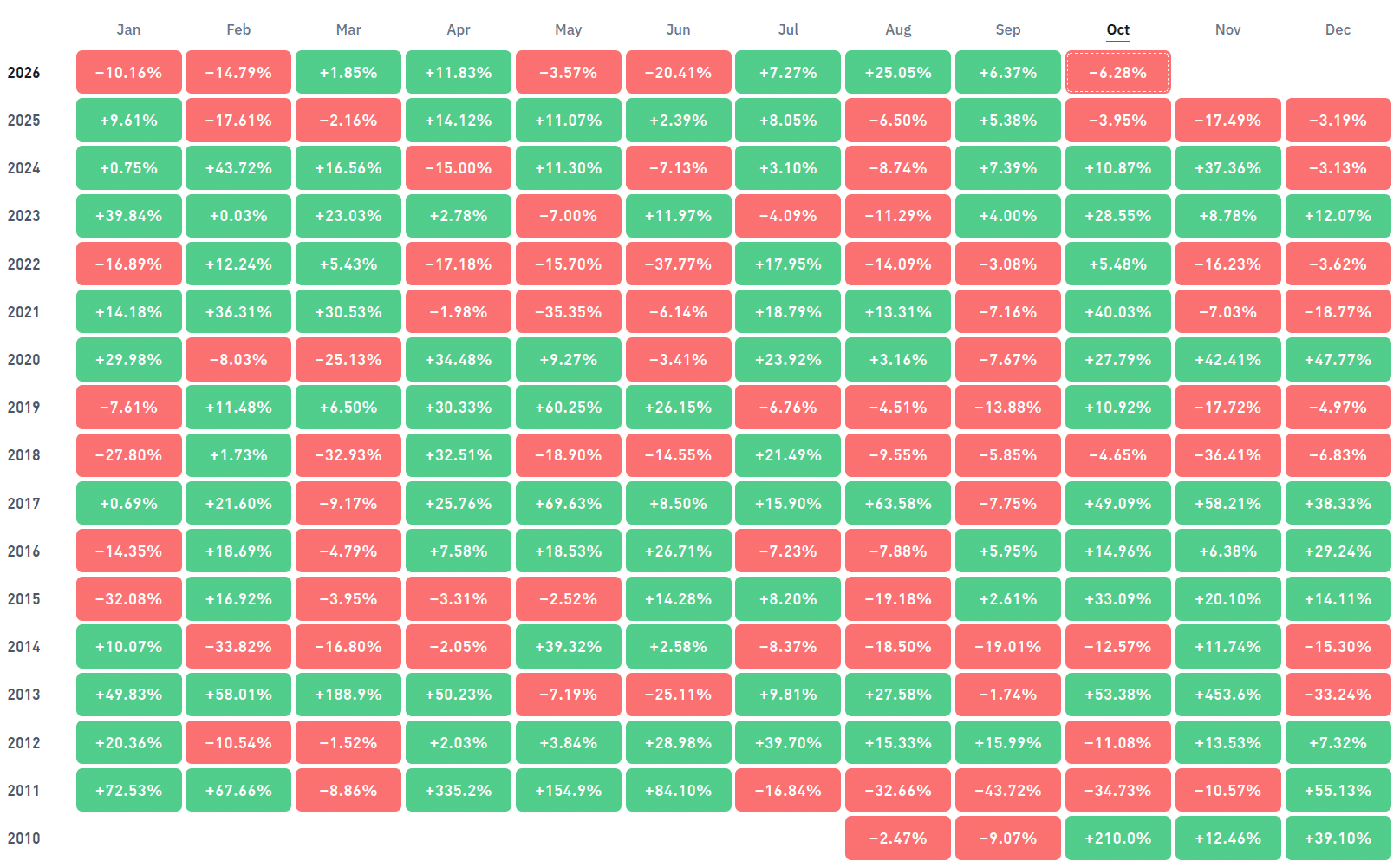
After two straight months of seasonal outperformance, digital asset prices finally underperformed last month. Then again, October sets a high bar: it has historically been one of Bitcoin’s strongest months – see image- earning it the affectionate sobriquet Uptober. (No one ever said investing is easy!). Bitcoin opened the month near $83,600, but finished below the $80,000 mark, roughly a third below its October 2025 peak. US spot Bitcoin ETFs reflected the same hesitancy, with total AUM stable over the month around $104bn.
Bitcoin Historic Monthly Returns
Source: coinglass
The lacklustre performance was reflected in our flagship large-cap Top 10 Crypto CTI, declining by -14.7% over the month, mainly as a result of the continued challenging macro backdrop. September’s US inflation data certainly offered little encouragement to investors.
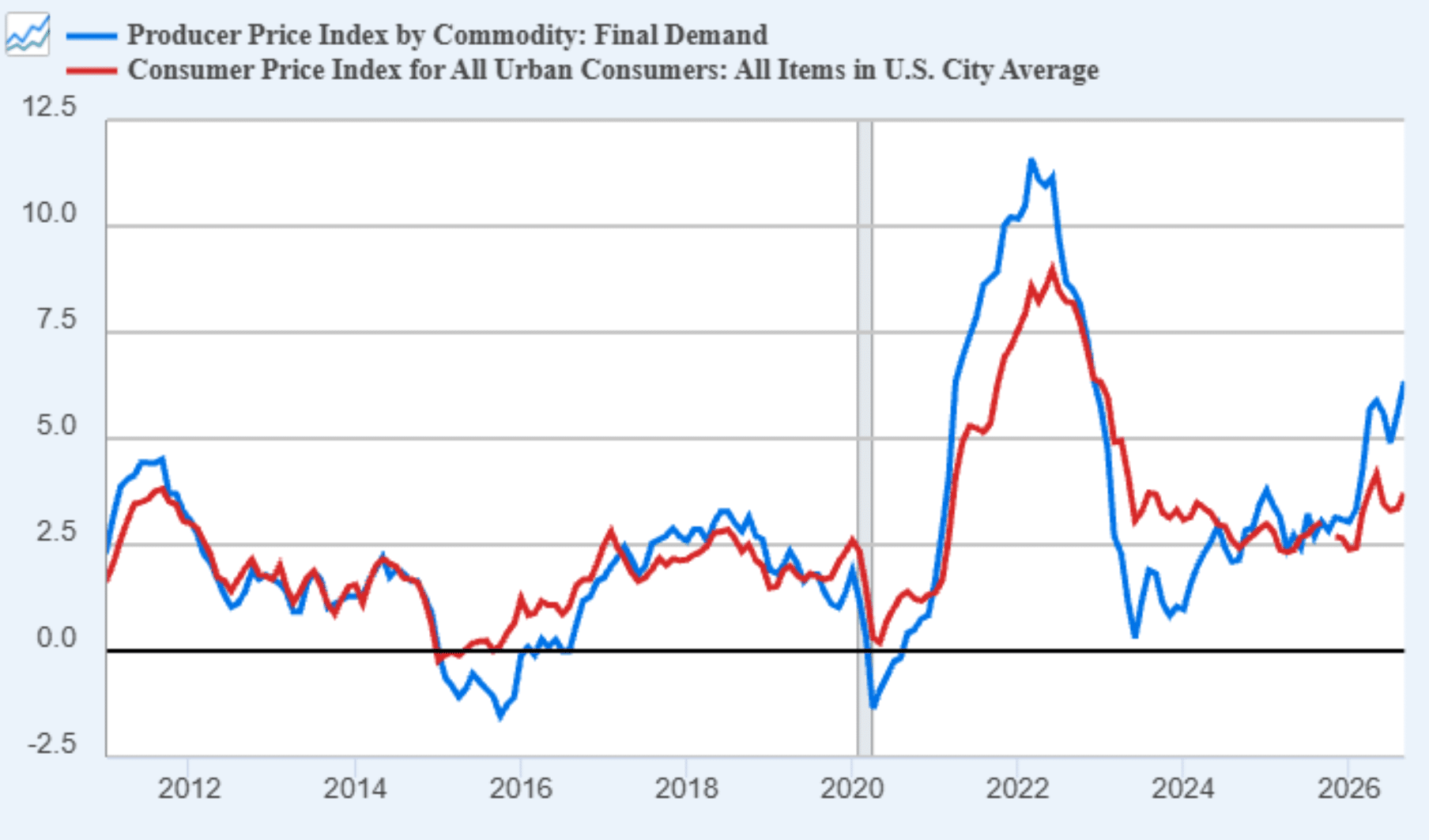
Consumer price inflation rose to 3.7% in September against expectations of 3.6%, while the producer price index (PPI) came in even hotter – see image – at 6.3% against an expected 5.3%, suggesting that pipeline price pressures remain significant. Energy was the main culprit: it accounted for more than half of the monthly rise in CPI, with gasoline up 9.1% in the month amid the Middle East conflict, which makes this partly a supply shock.
US Consumer and Producer Price Annual Inflation Rate
Source: Fred database
With inflation showing few signs of returning to the Fed’s 2% target any time soon, markets continued to price in a further 75bp of tightening by the middle of next year – starting with a 25bp hike in December – according to the CME Fedwatch tool.
At the October 28 press conference, Chair Warsh described US economic activity as expanding at a strong pace, with resilient domestic spending and job gains keeping pace with the workforce1. The Committee held the funds rate at 3.75-4.00% after a 10-2 vote, with Cook and Hammack both wanting a quarter-point hike, following September’s increase. Warsh also said he was unwilling to call financial conditions “tight”, which further cemented expectations of a December hike.
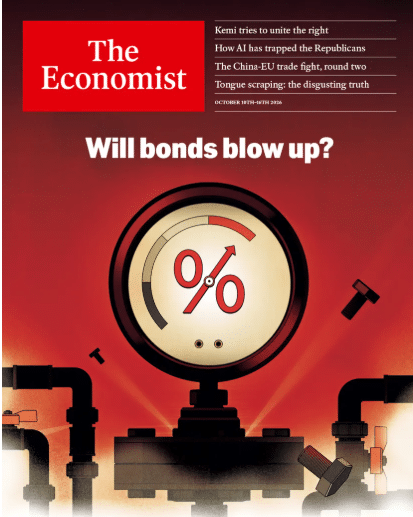
One might expect that, with such a macro backdrop, government bonds would remain under pressure. After all, the bearish momentum of recent months had driven US Treasury yields to their highest levels since the early 2000s (the 10-year touched 5.34% and the 30-year 5.70% in early October). That would, however, have been wrong. Indeed, with its usual impeccable timing, the front cover of The Economist magazine – a counter indicator whose reliability is on a par with CNBC’s Jim Cramer – questioning when the bond market will blow up coincided with the near-term top in yields.
The Shoe Shine Boy In Print
Source: The Economist
The reversal in yields coincided with a sharp sell-off in AI-linked equities, as investors revisited one of the more popular doomster narratives: namely, that artificial intelligence, like the dotcom boom almost three decades ago, is yet another tech bubble waiting to burst. The Nasdaq experienced its largest one-day drop since July on October 14, and CoreWeave, a bellwether for AI-related credit, fell by as much as 15–16% that day. Combined with excessive short positioning as investors bet that the rise in yields would persist, this was a sufficient catalyst to trigger the significant 30bp pull-back in yields on the US 10-year Treasury last month despite the hot CPI and PPI prints; a timely reminder to investors that financial markets rarely move in a straight line.
It also revived an important question that is very pertinent to crypto investors: does this move lower in Treasury yields undermine the fiscal dominance hypothesis that many (ourselves included) believe has been driving bond yields and digital asset prices higher over recent months (by raising term premia while also fuelling demand for debasement hedges)?
A Fundamental Return
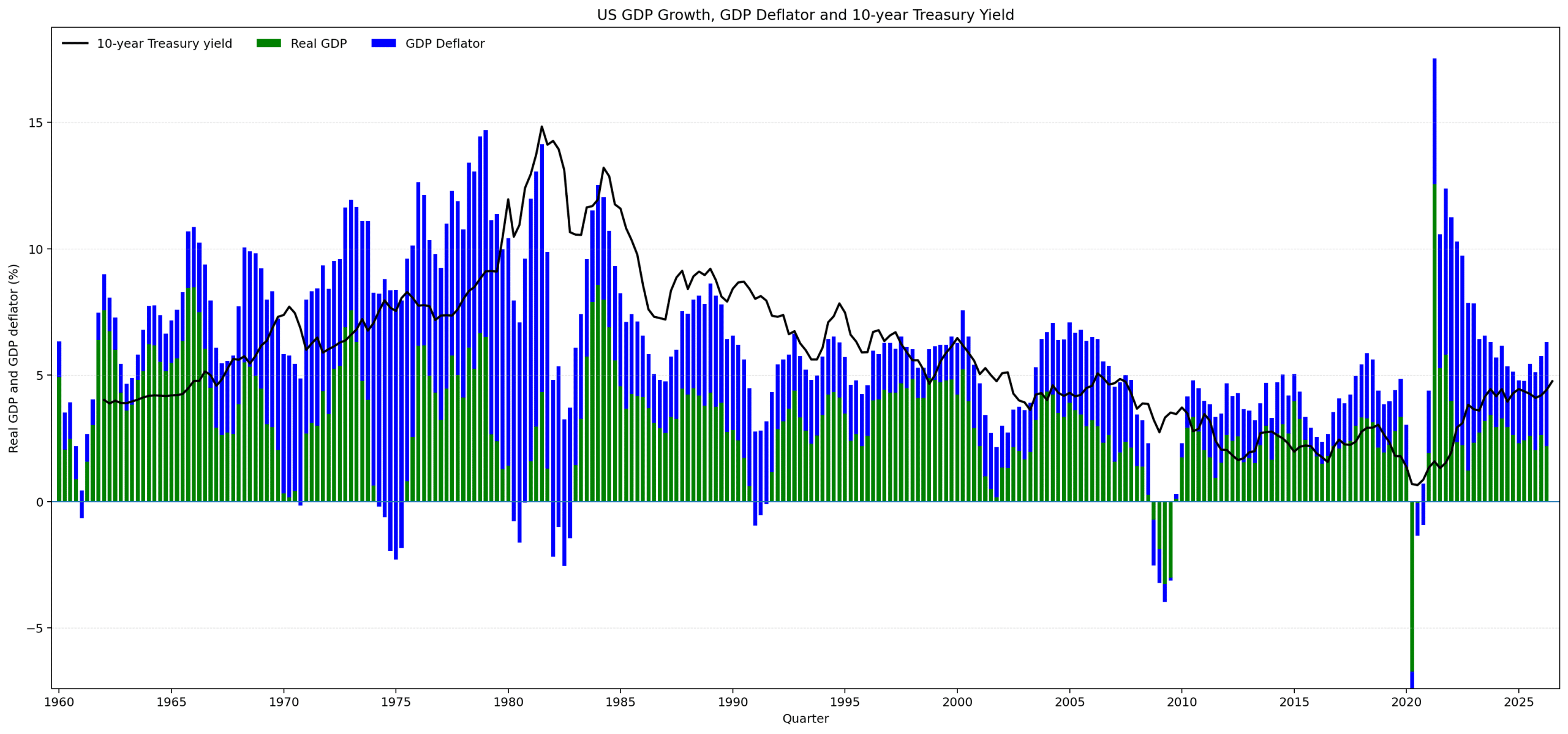
The common rebuttal to the fiscal dominance hypothesis is that the rise in yields simply represents a return towards underlying fundamentals. As the chart below illustrates, comparing the 10-year US Treasury yield with US nominal GDP growth, the two series tracked each other reasonably closely until the 2008 GFC. Since then, the former has generally remained below the latter, a divergence reflecting not just changing economic fundamentals but also extraordinary monetary accommodation, quantitative easing (QE) and policies that suppressed market interest rates.
US 10-Year Treasury Yield vs Nominal GDP Growth
Source: FRED database
For value investors who believe the relationship is a useful historical benchmark, the implication is that government bonds are the most attractive they have been for much of the past decade. However, there is an important qualification. Nominal GDP growth is not a direct measure of the fair value of a Treasury yield, because the latter also incorporates expectations for future interest rates and inflation, along with a term premium. The chart therefore provides context rather than proof that bonds are cheap.
Some commentators took an even more provocative stance (see below).
Questioning The Narrative

Source: X
The scenario outlined by Perkins — the Fed tightens too aggressively, the AI bubble bursts and Treasury yields plunge — is certainly plausible, but it is a cyclical argument, whereas fiscal dominance is a structural one. The two operate on different time horizons and need not be mutually exclusive.
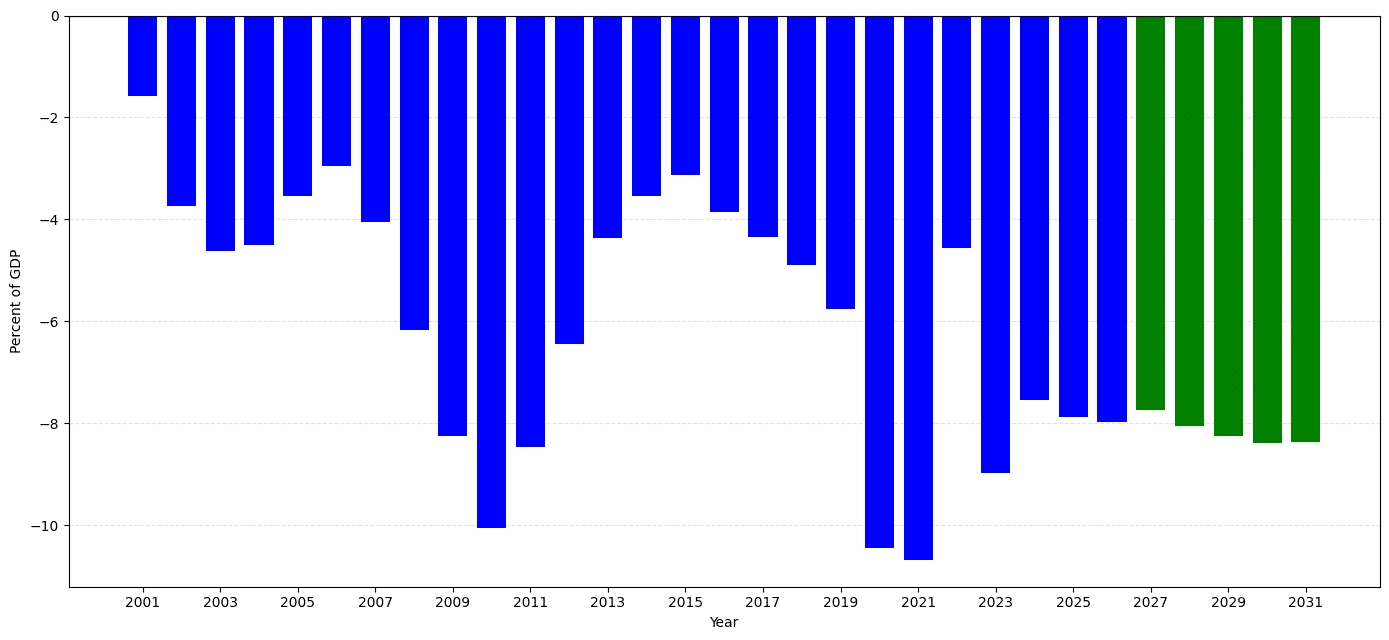
As outlined in the previous Monthly Update, the fiscal dominance thesis rests on the premise that persistent government borrowing eventually constrains monetary policy. The implication is that the US fiscal problem is not simply the consequence of a weak economy: substantial deficits remain even after adjusting for the economic cycle, as the chart below shows.
US Cyclically Adjusted Budget Balance (% of GDP)
Source: IMF Fiscal Monitor (green denotes IMF projections)
To paraphrase the great economist Rudi Dornbusch, economic expansions do not die of old age; they are murdered by the Fed. But murdering the economy does little to repair the budget. If anything, it makes matters worse: tax receipts decline, automatic stabilizers kick-in and governments face pressure to provide additional support. Indeed, US budget deficits have historically reached around 10% of GDP or more during severe economic downturns (such as 2008/9 and 2020/21).
Critically, there is no easy way out. Closing a structural budget deficit requires either spending cuts or tax hikes. As we have noted on many previous occasions, the former is seemingly politically impossible, while the effectiveness of the latter is doubtful, as the tax burden of many economies is near record highs, implying they may be approaching the point on the Laffer curve beyond which higher tax rates yield diminishing additional revenue.
Moreover, such a policy response to an economic bust is precisely what fiscal dominance predicts. After all, the key lesson of both the GFC and the Covid pandemic is that governments treat a crash as a licence to spend more, not less, frequently alongside a fresh round of QE. A Fed cutting rates and expanding its balance sheet to support a heavily indebted government while inflation is still above target would be the regime in action, not a refutation of it.
Nor do falling yields settle the matter. Yields fell during both of these episodes while debt carried on climbing, because a bust triggers a flight to safety and lower growth expectations, which says little about long-run fiscal sustainability. The telltale signs lie elsewhere: in the central bank’s tolerance for above-target inflation, in real yields and in the term premium. If term premia and real yields were to fall while the Fed holds the line on inflation, that would count against the thesis.
Are We There Yet?
That said, as we noted in the aforementioned Monthly Update, the Fed is, so far at least, behaving like a central bank that continues to put its inflation mandate ahead of the supporting the US Treasury’s financing needs. The real test, though, does not come in the hiking phase it but afterwards, namely, whether the Fed holds its nerve through a deep recession and a debt-servicing or market-functioning scare, or pivots to cuts and balance-sheet support with inflation still elevated. Far from looking silly, fiscal dominance would be a beneficiary of the Perkins scenario rather than a casualty. What would genuinely invalidate the thesis is not a single cycle, however dramatic, but a sustained move to primary fiscal surpluses and a structurally lower cyclically adjusted deficit, and there is no sign of that happening.
Black “Tech”tober
While the fiscal dominance debate highlights the potential vulnerabilities of an increasingly indebted financial system, October provided a rather different reminder of the risks facing modern finance. The month has historically been associated with financial turmoil in traditional markets, from the Panic of 1907, which helped spur the creation of the Federal Reserve, and the Wall Street crash of 1929, which foreshadowed the Great Depression, to the one-day 22% plunge in US equities in October 1987.
This October’s troubles were less financial than technological in nature, but they exposed a vulnerability that is arguably just as consequential: the digital infrastructure on which much of modern finance depends. A series of incidents highlighted the fragility of this increasingly interconnected system, while AI is beginning to play a growing role in identifying – and potentially exploiting – its weaknesses.
The most striking episode involved PHP, the programming language used by a substantial proportion of the world’s websites (estimates run as high as 70%). Two critical remote-code-execution vulnerabilities, collectively dubbed “PHP2Shell” and allowing unauthenticated attackers to run code on a server, were disclosed late in the month after details leaked ahead of the planned patch release. Both were rated 9.2 on the Common Vulnerability Scoring System (CVSS), placing them firmly in the critical category.
The response was unusually far-reaching. Japanese PM Sanae Takaichi urged organizations to check whether their websites used PHP and to apply the patch immediately, or temporarily suspend services if they could not. Warnings also came from several major cybersecurity agencies, including the US Cybersecurity and Infrastructure Security Agency (CISA), the FBI’s cyber division, the US National Security Agency, the EU’s CERT-EU and Britain’s National Cyber Security Centre .
In response, many businesses, banks and government departments took websites offline while applying fixes, highlighting how a vulnerability in a widely used component can ripple across otherwise unrelated organizations.
The episode was particularly instructive because AI played a central role in the discovery process. OpenAI said one of its models found the flaws during a security audit of PHP that began in July under its Patch the Planet programme. The flaws reportedly affect versions dating back to PHP 5, but exploiting them required a complex chain of steps that had been difficult to identify and execute. AI has lowered that barrier, and the implication is double-edged. The same technology that helps researchers uncover vulnerabilities also makes it easier for attackers to identify and exploit weaknesses.
The episode became more concerning when details of the vulnerabilities leaked before the coordinated disclosure process was complete. PHP brought forward its patch release, while Amazon’s threat-intelligence team subsequently reported an exploitation attempt that had occurred before public disclosure. Cloudflare also reported attack traffic before the patch was released. The attacker’s source of information remained unclear.
The lesson is not that AI inevitably makes the internet less secure, but that it is changing the economics of cybersecurity. Organizations may be able to find and fix weaknesses more quickly, yet they also face greater pressure to respond before attackers can exploit them.
4!!!
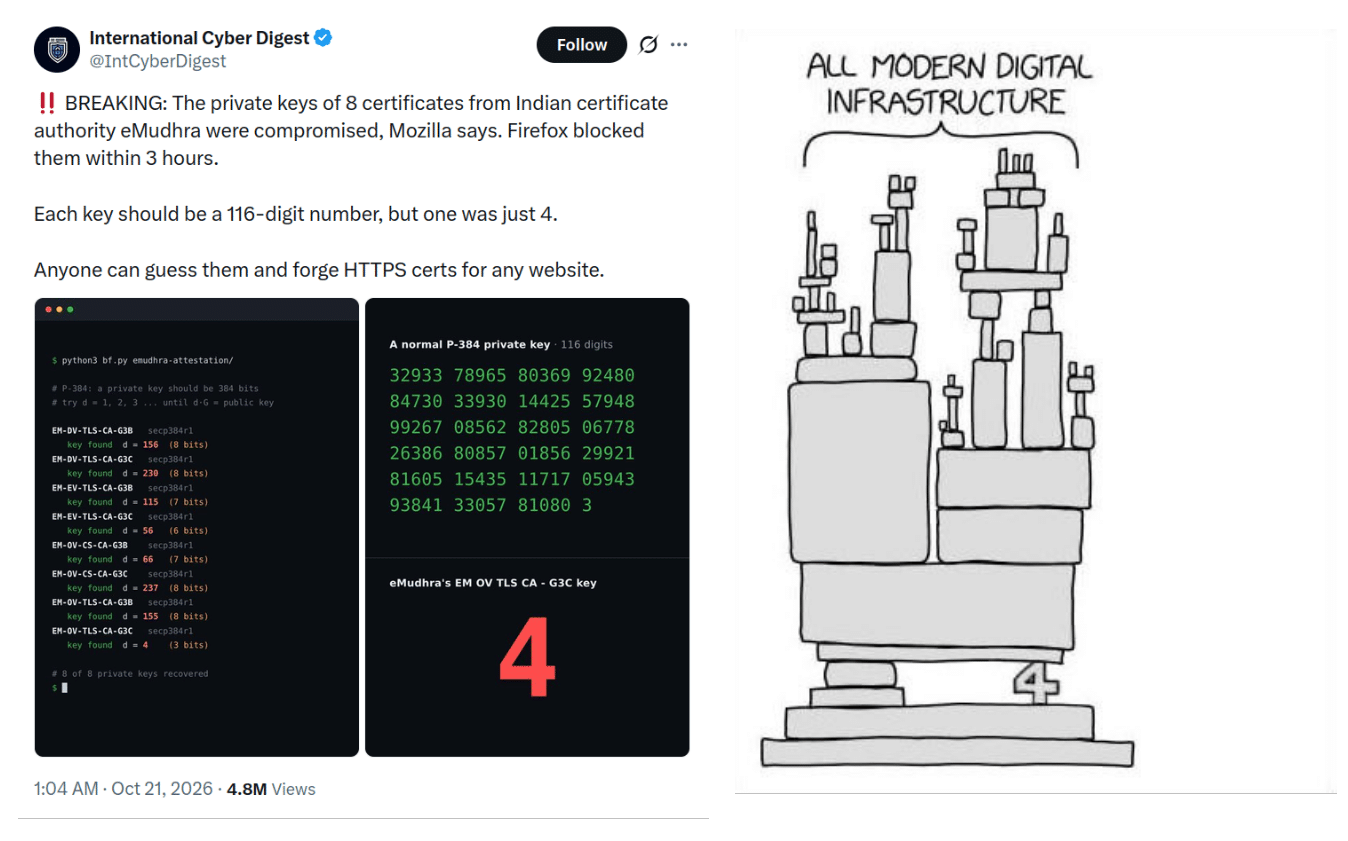
If the PHP episode illustrated the growing challenge of securing widely used software, a separate incident involving the Indian certificate authority eMudhra highlighted the risks of relying on trusted intermediaries. Eight intermediate certificates issued by the company (six for websites and two for code signing) were found to be protected by cryptographic keys so weak that they could be recovered by testing just 256 possible values. In one case the private key was, quite literally, the number 4.
Pick A Number?
Source: X
The problem reportedly arose from a faulty script that generated a second, weaker set of keys. Staff selected these by mistake because their labels resembled those of the intended keys. The affected certificates had been generated in April 2025, leaving a weakness in the web’s certificate infrastructure that could potentially have enabled forged certificates to be issued. A researcher reported the flaw on October 17, around 17 months later.
Browser vendors and operating-system makers responded by blocking the affected certificates, with Mozilla subsequently removing trust in the root certificate that had signed them. eMudhra said that most of the certificates had never been used in production and that it had found no evidence they had been used to issue certificates to end users. It was also reported that no website certificate chaining to the six TLS intermediates had been logged in Certificate Transparency, the public record of issued certificates. The response shows the existing system can work once a flaw is found and reported, but here it depended on an outside researcher noticing the problem rather than on any safeguard in the design.
Centralized Trust
Importantly, the incident illustrates a fundamental problem with centralized trust systems. Digital certificates help browsers establish that they are communicating with the intended website, but their security depends on the integrity of the cryptographic keys and the organizations responsible for issuing and managing them. A seemingly trivial implementation error can therefore undermine a much larger system of trust.
If that wasn’t bad enough, the same day other vulnerabilities emerged across the software stack. Node.js issued security updates addressing ten flaws, four of them rated high, while GitLab released an emergency patch for a critical, unauthenticated remote-code-execution vulnerability affecting self-managed installations (rated 10.0, the maximum CVSS score).
Although the details differed, the incidents reinforced the same broader point: modern digital infrastructure relies on a vast network of software components, trusted certificates and interconnected services. A weakness in any one of them can create risks far beyond the organization that introduced it.
The banking system provided a further illustration of these dependencies. The day prior to the problems just mentioned a power event at Google Cloud’s London region disrupted access to financial services for millions of customers, with Revolut, Lloyds, Bank of Scotland and HSBC among the institutions reportedly affected. Separately, State Bank of India reported that thousands of customer records containing personal information had been leaked (3,897 records identified so far, against a hacker’s claim of some 375,000 that SBI has yet to verify), while stressing that its operations and transactions were unaffected.
The digital asset ecosystem was not immune to failure either. Exchanges, custodians, wallets, mining infrastructure and internet connectivity all introduce their own risks, and last month’s most expensive illustration came in its final days. On October 29, roughly $6.3 billion was drained from Binance, one of the world’s largest exchanges, in what blockchain analytics firm TRM Labs calls the largest crypto theft on record, about four times the $1.5 billion taken from Bybit in February 2025. TRM attributes the attack, with high confidence, to North Korea’s TraderTraitor group, while Binance’s preliminary findings point to a compromised engineer’s laptop rather than any leak of wallet private keys. Binance suspended withdrawals and said it would cover all losses from its SAFU fund and company resources, while Tether, Circle and others froze an estimated $2.7–3 billion of the stolen assets.
These incidents were not necessarily connected, and they should not be treated as evidence of a single systemic failure. That said, taken together, they highlight how much of modern finance depends on a relatively concentrated set of technology providers and trusted intermediaries.
Battle-tested Bitcoin
Importantly, the Binance incident exposed a vulnerability in a centralized custodian, not in the underlying Bitcoin protocol. The Bitcoin network continued processing transactions according to its established consensus rules, with blocks produced roughly every ten minutes on average and independently operated nodes verifying transactions and enforcing the protocol.
The contrast is stark.
A cloud provider’s power failure can disrupt services that depend on it; a compromised certificate authority can undermine confidence in websites; and a vulnerability in widely used software can expose thousands of organizations simultaneously. Bitcoin’s consensus system, by contrast, is designed to minimize reliance on central intermediaries through independently verifiable rules and a distributed network of participants.
This distinction could become increasingly important. As AI lowers the barriers to identifying and exploiting vulnerabilities in the centralized digital infrastructure underpinning much of modern finance, the relative appeal of decentralized systems that minimize the need for trusted intermediaries may grow. Bitcoin is perhaps the most prominent example.
This may not have been reflected in last month’s digital asset returns, in light of the challenging macroeconomic backdrop and the Binance hack, but that doesn’t make the underlying argument any less compelling.
1 That upbeat reading though is hard to square with the latest jobs data. September’s non-farm payroll report showed the economy adding just 29,000 jobs, barely a third of the consensus of around 90,000. Unemployment rose to 4.2%, and July and August were revised down by a combined 60,000.