

September 2026 in Crypto: Monetary credibility, Fiscal Reality

August and September are historically two of the weakest month’s of the year for digital asset returns (December being another notable soft spot), with median monthly returns in negative territory. However, as the chart below confirms, 2026 has been very much the exception, with both months witnessing solid positive returns.
Bitcoin Monthly Returns Since 2013 (Median vs. 2026)
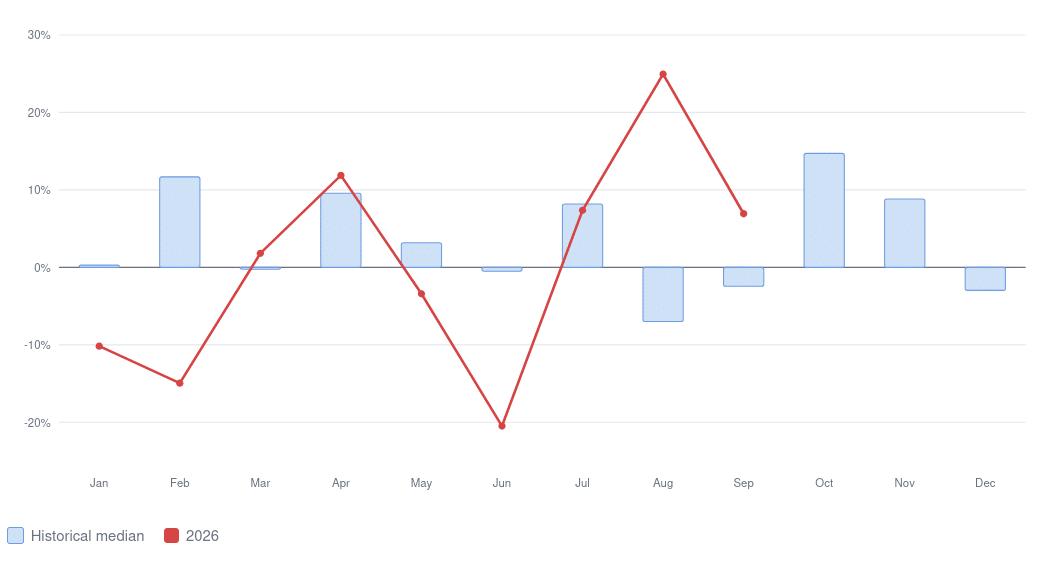
Source: Coinglass
In the previous monthly update I attributed this seasonal outperformance to the return of the debasement trade following the surprise announcement of the US Treasury to upscale the size of its government bond buy-back programme, which many investors took as confirmation of the veracity of the fiscal dominance narrative so popular in crypto circles.
September provided an important test of that thesis.
The Fed and other major central banks, including the BoJ and the ECB1, raised borrowing costs in response to renewed concerns over the near-term inflation outlook, driven primarily by the global energy-price shock associated with the US–Iran conflict in the Middle East. Crude oil prices revisited the $100-per-barrel mark, creating a particularly difficult environment for central banks: tighter monetary policy was required to contain inflationary expectations at precisely the moment when higher rates were increasing the fiscal burden on heavily indebted governments.
Yet, despite these monetary-policy interventions, crypto investors largely shrugged off the tightening. September’s return remained firmly positive, albeit more muted than August’s, as highlighted by the 11% gain in our flagship large-cap Top10 Crypto CTI.
To understand why, let’s dig in!
Fed Put To The Test
Headline CPI inflation in the US rose 0.4% m/m (3.4% y/y) in August, up sharply from July’s 0.1% monthly increase. More importantly, core CPI accelerated to 0.3% m/m from 0.2% m/m in July, leaving the y/y rate above the central banks 2% target rate for a 65th successive month. While energy accounted for more than one-third of the monthly headline increase, it was notable that shelter inflation also accelerated, suggesting the inflationary impulse was not entirely an energy story.
Prior to the release, markets had already moved towards pricing a hike following the Fed’s increasingly hawkish communication and the rebound in the US jobs data after a soggy July (August showed net job creation of 162,000, almost 3X consensus forecasts). However, the CPI report materially strengthened expectations of a September rate increase. The subsequent decision on September 16 confirmed this interpretation: the FOMC unanimously raised the target Fed Funds range by 25bp to 3.75–4.00% – it’s first rate hike in three years – explicitly stating that inflation remained elevated and that the move was intended to support a timelier return to its 2% objective.
The significance of the decision goes beyond the 25bp increase, which in the grand scheme of things is a relatively modest interest rate adjustment. With inflation having remained above target for such a prolonged period, the Fed needed to demonstrate that its reaction function remained governed by its price-stability mandate rather than by pressure to reduce borrowing costs — particularly in light of the previous month’s announcement by Treasury Secretary Bessent.
Moreover, Warsh’s rejection of forward-rate guidance, which, as noted previously, is in our judgment the most significant change in the modus operandi of the Fed under its new leadership, gives each policy decision greater importance. Rather than attempting to manage expectations by explicitly signalling the future path of interest rates, the Fed increasingly requires investors to interpret incoming macroeconomic data and respond to its decisions.
In other words:
“When the Fed speaks less about the future, the data have to speak more loudly.”
That places a greater premium on institutional credibility.
The Credibility Paradox
Orthodox macroeconomic theory posits that newly appointed central bankers face strong incentives to establish their credentials as inflation fighters. The reason is straightforward: greater credibility can help anchor private-sector inflation expectations, reducing the amount of monetary tightening required to restore price stability. All else equal, that should be supportive of government bond prices and therefore lower government borrowing costs — an outcome Treasury Secretary Bessent is clearly in favour of.
The difficulty is that the long end of the curve is not determined solely by expectations of future short-term interest rates. It also incorporates a term premium: compensation to investors not only for future inflation and interest-rate uncertainty, but also for duration and fiscal risk.
Governor Waller, a member of the Fed Board of Governors, recently highlighted precisely this issue. He argued that the traditional safety premium associated with US Treasuries had largely disappeared, while fiscal deficits and competition for capital from AI infrastructure investment were contributing to a higher neutral rate. He also argued that structural deficits need to fall substantially for the US to grow its way out of its debt burden.
It is against this backdrop that last month’s upscaled Treasury buyback programme becomes particularly interesting.
Swing And Miss?
The US Treasury significantly increased the size of its long-end buyback operations beginning September 9, doubling the previous maximum operation size from $2bn to at least $4bn. The intention was to provide liquidity support to longer-dated nominal Treasury securities and, indirectly, improve market functioning and borrowing conditions. Yet despite buying $6bn of long-term Treasuries, yields at the back end of the curve subsequently rose, with the 10-year yield reaching around 4.85%.
Given the operation’s stated aims, this does not necessarily mean it was a failure, but it is probably fair to conclude that the outcome was less convincing than Treasury might have hoped (especially as the Move bond volatility index has ratcheted higher over the past couple of weeks). It is also a useful warning that such interventions cannot overcome a structurally higher term premium. If investors are demanding greater compensation for fiscal risk, inflation risk or the opportunity cost of allocating capital to Treasuries, relatively modest buyback operations are unlikely to reverse the underlying trend in long-term yields.
Running on Faith
The real test of whether the evolving monetary-fiscal framework will remain sustainable rests on whether bond investors retain confidence in the trajectory of the US public finances, which is questionable now that US federal debt has surpassed $40tn.
In a bid to boost confidence, Treasury Secretary Bessent recently argued that the US can “grow its way out” of the debt burden. The arithmetic behind that proposition is straightforward: debt sustainability depends not just on the size of the deficit, but on the relationship between the interest rate paid on government debt, nominal economic growth and the primary fiscal balance.
The basic debt-dynamics equation can be expressed as:
Δb ≈ [(r − g)/(1 + g)] × b − pb
where:
- pb = the primary balance as a percentage of nominal GDP;
- r = the nominal interest rate paid on government debt;
- g = nominal GDP growth, comprising real growth plus inflation;
- b = the debt-to-GDP ratio; and
- pb* = the primary balance required to stabilise the debt-to-GDP ratio.
Assuming an average interest rate on the existing US debt stock of approximately 3.3%, nominal GDP growth of around 4.4% and debt held by the public equivalent to approximately 101% of GDP — the US can run a primary deficit of roughly 1.1–1.2% of GDP ad infinitum while keeping the debt ratio broadly stable. The problem is that the actual primary deficit is substantially larger, at approximately 2.6% of GDP.
Furthermore, the 3.3% average interest rate on the existing debt stock is considerably below the current Treasury yield curve. As cheaper legacy debt matures and is refinanced at higher rates, the effective interest rate on the government’s debt stock will gradually rise even without additional Fed hikes. If the average interest rate on the debt stock eventually rose towards 4.5%, the primary balance required to stabilise the debt ratio would move close to balance under the assumptions above. Around current market rates, the required primary balance is in surplus territory.
Obviously, the precise numbers will change as economic growth, inflation, debt issuance and the maturity structure of the Treasury portfolio change. Nevertheless, the important point is the direction of travel: the higher the effective interest rate relative to nominal GDP growth, the greater the fiscal adjustment required simply to prevent the debt-to-GDP ratio from rising.
This is why “growing out of the debt” is a much higher hurdle than it initially appears. If nominal growth is generated primarily through real economic growth rather than higher inflation, the real growth rate would have to accelerate dramatically to offset a substantially higher interest burden.
For example, under the assumptions above, if the effective interest rate eventually moved towards 4.5% while the primary deficit remained around 2.6% of GDP, nominal GDP growth would need to approach 7% simply to stabilise the debt ratio. With inflation around 2.2%, that would imply real GDP growth of roughly 4.7% — more than twice the current trend rate. That is a very high hurdle.
AI is the obvious wildcard. Estimates of its potential contribution to productivity vary enormously, but the range many investors regard as plausible is between roughly 0.5 and 1.4 percentage points of additional annual growth. This would represent a material improvement in the US growth rate, but even the upper end of that range would not, by itself, eliminate the need for fiscal consolidation if borrowing costs remain materially above nominal growth.
A Mid-term Fiscal Bribe?
What makes matters even more challenging is that the political incentives surrounding fiscal expansion can remain powerful even when the economic case for consolidation is becoming stronger. Consider President Trump’s recent proposal to issue a $5,000 “Trump Dividend” to every adult US citizen if Republicans win both the House and Senate.
While politicians since the dawn of time have always over-promised to get elected, by explicitly connecting the cheques to the outcome of a single election, optically it looks very much like a bribe. Not only that, but as there an estimated 270 million adult citizens in the US the cost of this single fiscal measure alone exceeds $1.2tr. With federal debt already above $40tn — more than 100% of nominal GDP — this is hardly the sort of proposal likely to reassure investors concerned about the long-term trajectory of US public finances – see image.¹
US Federal Debt Held by the Public (% GDP)
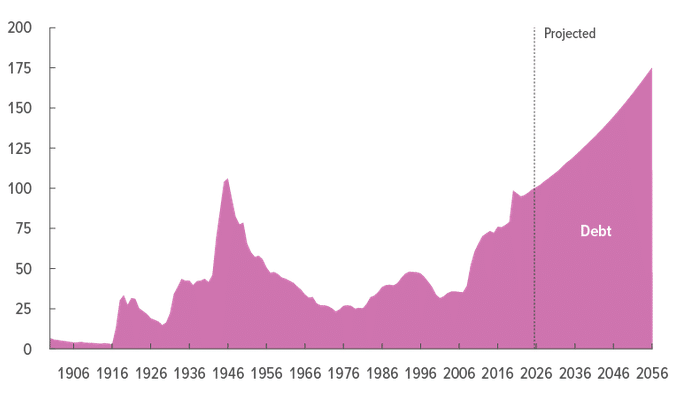
Source: CBO
The more important point, however, is not whether this particular proposal becomes law; unlikely as Congressional approval would be required. Rather, it illustrates the political difficulty of implementing sustained fiscal consolidation in an environment where voters and politicians remain sensitive to the economic costs of higher taxes and lower government spending. And this is where the analysis of monetary and fiscal policy becomes particularly relevant.
The Unpleasant Arithmetic
In their seminal 1981 paper, Some Unpleasant Monetarist Arithmetic, economists Thomas Sargent and Neil Wallace demonstrated why monetary policy cannot ultimately be analysed independently of fiscal policy.
In the conventional monetary-policy framework, the central bank raises interest rates when inflation is too high. Higher rates reduce aggregate demand and, with sufficient credibility, help bring inflation back towards target. Crucially, however, this framework assumes that fiscal policy ultimately accommodates monetary policy: the government adjusts its fiscal position sufficiently to ensure that public debt remains sustainable.
Sargent and Wallace considered the opposite possibility. If fiscal policy is effectively predetermined and persistent budget deficits continue regardless of monetary policy, tighter monetary policy creates an additional problem: higher interest rates increase the government’s interest burden. If the fiscal authority does not respond by reducing primary deficits, the additional interest expense must eventually be financed somehow. The implication is that although a central bank can control inflation in the short term through higher interest rates, its ability to determine the long-run inflation rate ultimately depends on the fiscal regime supporting it.
This is where my earlier analysis of the relationship between monetary and fiscal policy becomes particularly relevant.
In a 2022 research note, Fed Fears, I argued that when government debt is high, the fiscal consequences of monetary policy become increasingly important.
The key point was:
“When debt-to-GDP is high and rising, these spillovers are considerably greater and sometimes monetary and fiscal policy objectives (debt sustainability) clash.”
At some point, central bankers could face an uncomfortable choice. They can maintain sufficiently restrictive real interest rates to preserve monetary credibility, but at the cost of putting increasing pressure on the fiscal position. Or they can tolerate somewhat higher inflation and lower real rates, allowing nominal GDP growth and inflation to reduce the real burden of outstanding debt. This does not mean that inflation necessarily becomes the chosen outcome, nor that an independent central bank is destined to accommodate fiscal policy. It does, however, highlight the constraint imposed by fiscal arithmetic.
If fiscal policy remains persistently expansionary, maintaining positive real interest rates becomes increasingly expensive for the government. That is precisely the dynamic that informed the conclusion of our 2022 research note:
“Monetary policy cannot succeed on its own.”
For finite-supply digital assets such as Bitcoin, the potential implication is important. Absent fiscal tightening, monetary tightening may be a short-term price depressant because higher real yields tighten financial conditions and increase the opportunity cost of holding non-yielding assets. But if persistent fiscal imbalances eventually make sustained positive real rates politically or economically difficult to maintain, the longer-term implications are the polar opposite. In other words, the same monetary tightening that creates a headwind for Bitcoin in the short term can, under certain fiscal conditions, strengthen the long-term case for scarce assets by increasing concerns over the sustainability of fiat purchasing power.
Japan: A Historical Warning
If the US fiscal arithmetic appears uncomfortable, Japan provides an even more extreme example. Japan’s gross government debt-to-GDP ratio is more than twice that of the US. Remarkably, this is not the first time in living memory that Japanese government debt has reached such exceptionally high levels.2 As a consequence of World War II, Japanese government debt was estimated to have risen to 266% of GDP by 19443.
When confronted with such a large nominal debt burden, there are broadly three mechanisms through which the debt ratio can be reduced:
- Fiscal consolidation — generating sufficiently large primary surpluses;
- Growth — generating nominal GDP growth that exceeds the effective interest rate on the debt; or
- Inflation and currency depreciation — allowing nominal GDP and prices to rise faster than the nominal value of liabilities, thereby reducing their real burden.
These mechanisms are not mutually exclusive. Nevertheless, in the immediate aftermath of World War II, rather than reducing the debt burden through conventional fiscal consolidation or faster economic growth, Japan relied most heavily on option three. Wholesale prices, the preferred inflation measure at the time, increased almost 90-fold between 1944 and 1949. This dramatically reduced the real value of outstanding government liabilities and helped bring the debt-to-GDP ratio down to just over 20%. The adjustment in the external value of the Japanese currency was equally extraordinary. From ¥4.27 per US dollar in 1940, the exchange rate reached ¥360 per dollar by April 1949 — an increase of more than 80X!!!
Even though Japan’s public debt ratio is not a million miles away from the levels witnessed in the post-war period, a direct replay is clearly not on the cards. For a country deeply integrated into global manufacturing supply chains and heavily dependent on imported energy a currency collapse of anywhere near the same magnitude as in the 1940s would be the economic equivalent of another Hiroshima or Nagasaki!
Rather the important takeaway from this historical episode is that it demonstrates when public debt burdens are very large – as they are in Japan and many other major economies today – governments are often forced into policy choices with economic and financial consequences far beyond most investors’ experience.
Nothing in Warsh’s current operating framework suggests that the Fed is preparing for such a radical departure from the monetary-policy regime of the past several decades. Indeed, the September rate increase points in the opposite direction: the Fed is currently demonstrating its willingness to tighten policy in response to elevated inflation. But the lesson of Sargent and Wallace remains relevant.
Faced with an intransigent fiscal authority that either will not, or cannot politically, implement sustained fiscal consolidation (and nothing from Team Trump, or other governments in many other developed countries suggests the contrary) central bankers will eventually face a difficult choice between maintaining monetary discipline and accommodating a fiscal position that is becoming increasingly difficult to sustain. History suggests that in the end, it is the central bank and holders of nominal government bonds that end up paying the price, the former because of the loss of operational independence and the latter because the value of their holdings in real terms diminishes.
Why This Matters for Crypto
This brings us back to digital assets.
Conventional wisdom holds that rising real interest rates tighten global liquidity and increase the opportunity cost of holding non-yielding assets, generating headwinds for gold and finite-supply cryptocurrencies such as Bitcoin. This is exactly what happened in 2022, when it became clear that the pandemic-induced surge in inflation was not merely “transitory”. However, the strong performance of digital asset markets since suggests investors are increasingly looking beyond the immediate monetary-policy cycle and focusing instead on the longer-run tension between monetary and fiscal policy, a tension which, if anything, is even greater today than it was back then.
In other words, the relevant question for investors is not whether the Fed can establish its credibility as an inflation fighter by raising the Fed funds rate by 25bp. It can. The more important question is this: can monetary credibility ultimately survive a fiscal environment in which maintaining positive real interest rates becomes increasingly costly.
That was the question crypto investors asked themselves last month and the answer came in the form of a green up-candle!
1 The BoE refrained from hiking last month, but comments from Governor Bailey suggest it was only a temporary reprieve to assess the impact of the autumn budget slated for October 28 – see: https://www.reuters.com/world/uk/boes-bailey-says-high-energy-prices-make-it-harder-leave-rates-hold-2026-09-25/
2 Japan is one of the world’s leading nations for life expectancy. In fact, it just hit a new longevity milestone with more than 100,000 people living more than a century – see: https://www.scientificamerican.com/article/japan-just-hit-a-new-longevity-milestone/
3 An IMF historical reconstruction produces an even higher estimate of around 484% of GDP.


